
Generative AI for visual merchandising is no longer a futuristic concept it is the defining force reshaping the retail landscape in 2025. This revolutionary technology is moving beyond static planograms and seasonal themes, empowering brands to create dynamic, responsive, and deeply personalised store environments. The very canvas of retail space is becoming intelligent, adapting in real-time to data, trends, and the individual customer.
For decades, visual merchandising relied on manual intuition, cyclical campaigns, and a one-size-fits-all approach. This process was not only time-consuming and costly but also inherently limited, unable to personalise the in-store experience at scale or react swiftly to shifting consumer behaviours. The static nature of traditional design often meant missing crucial opportunities to engage and captivate the modern, data-driven shopper.
Today, that paradigm is being completely overturned. We are entering an era where AI algorithms generate immersive window displays, optimise floor plans for maximum engagement, and craft personalised product arrangements tailored to local demographics and even real-time inventory. This introduction marks the beginning of a comprehensive exploration into how the 2025 revolution in retail design is unfolding, moving from imagination to tangible, operational reality.
How Generative AI for Visual Merchandising Actually Works in Retail Design
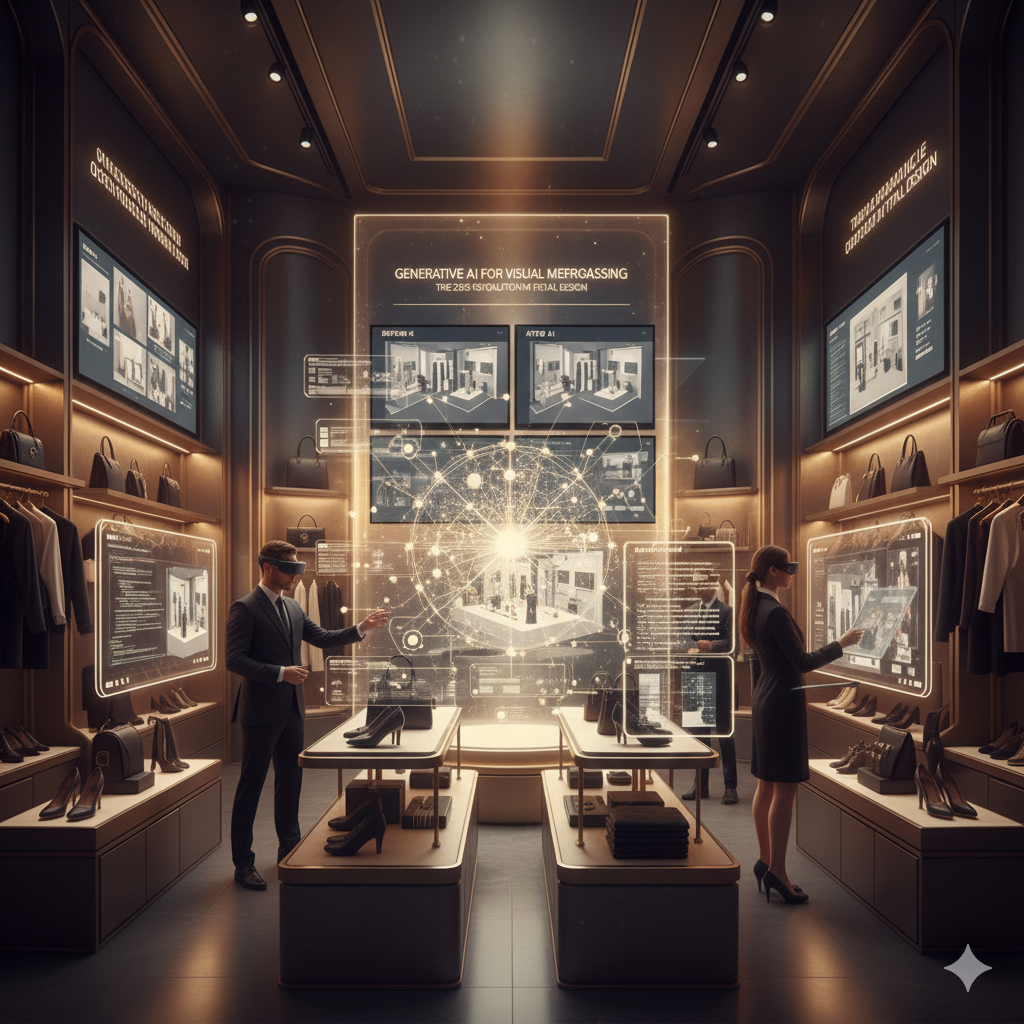
The magic of Generative AI for Visual Merchandising begins not with creation, but with ingestion. The system is fed a massive, multifaceted dataset historical sales figures, real-time foot traffic sensors, CRM data, social media trend reports, weather patterns, and thousands of images of award-winning store layouts. It analyses this data to understand profound correlations: how lighting affects sales, which product pairings drive impulse buys, or how aisle curvature influences dwell time. This foundational knowledge allows the AI to move beyond automation to intelligent, informed generation.
Once trained, the process is a dynamic dialogue. A visual merchandiser provides a strategic prompt, such as Create a summer window display for our new athleisure line targeting Gen Z. The AI, powered by Generative AI for Visual Merchandising, processes this against its training and real-time data, generating a range of original, context-aware concepts and data-backed layout suggestions.
The output is where the true 2025 revolution lies. The technology doesn’t produce a single, rigid command. Instead, it generates a spectrum of creative options photorealistic mock-ups, 3D merchandise arrangements, or heat-mapped floor plans predicting customer flow. Crucially, each is accompanied by the AI’s data-driven reasoning. This transforms the designer’s role from manual executor to strategic curator and creative director.
The next frontier is advanced simulation and iteration. Using a digital twin of the store, Generative AI for Visual Merchandising can simulate the performance of a proposed design before implementation. It models customer journeys, predicts engagement hotspots, and forecasts sales impact. Designers can request adjustments to make it more minimalist, and the AI regenerates proposals in seconds, showing the simulated outcome of each tweak.
Finally, the system establishes a closed-loop, learning ecosystem. Once a design is live, IoT sensors and POS data measure its real-world performance. This data is fed directly back into the model. Every campaign becomes a learning experience, making the Generative AI for Visual Merchandising system smarter, more attuned to specific customers, and more effective with each cycle. It doesn’t just design; it learns, adapts, and continually evolves the retail space.
Finally, the system establishes a closed-loop, learning ecosystem. Once a design is implemented in the real world, its performance is continuously measured. IoT sensors track dwell time and engagement, while POS data monitors sales lift. This performance data is fed directly back into the AI model. In this way, every implemented campaign becomes a learning experience, making the system smarter, more attuned to that specific location’s customers, and more effective with each cycle. The AI doesn’t just design; it learns, adapts, and continually evolves the retail space.
Dynamic Window Displays That React in Real-Time
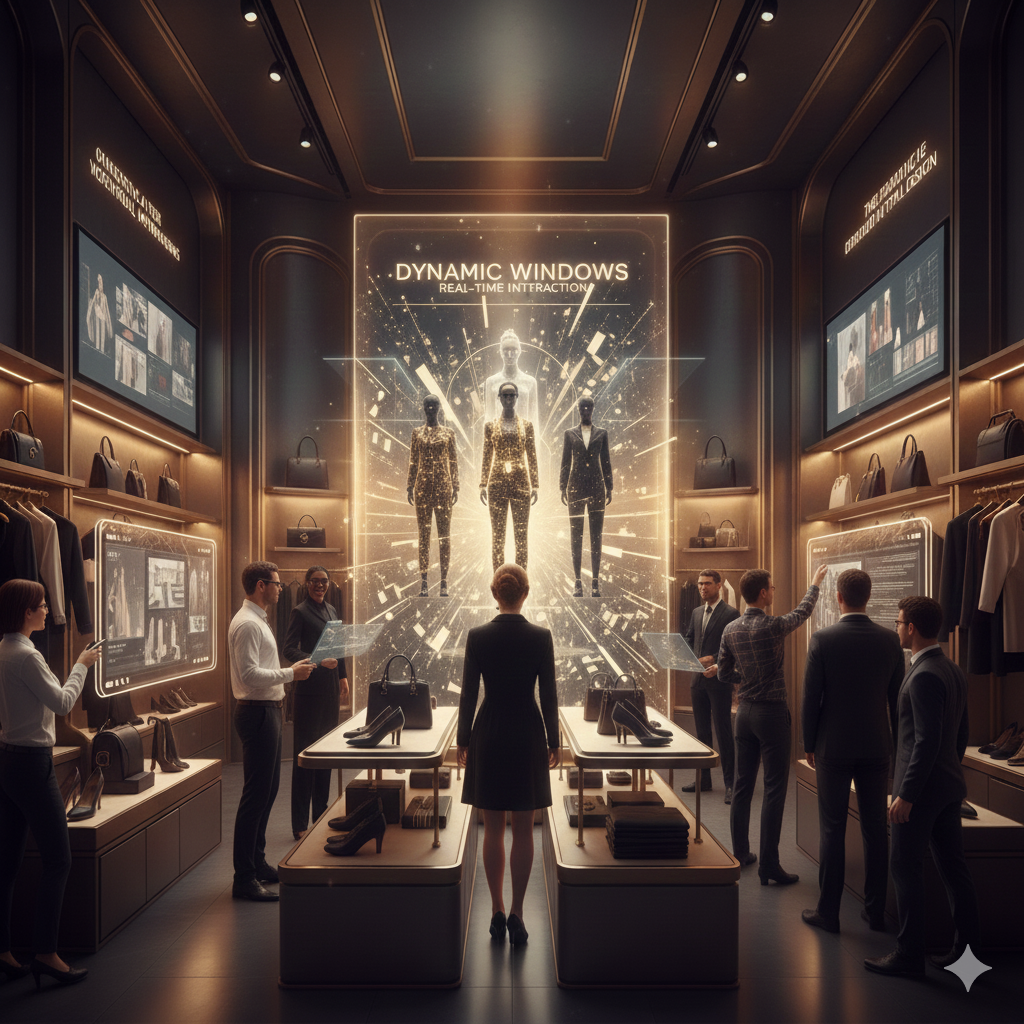
Gone are the days of the static, month-long window display. The storefront is being reimagined as a living, breathing interface between the brand and the world. Powered by generative AI, integrated sensors, and high-definition digital screens or advanced projection mapping, these dynamic displays transform from curated dioramas into responsive storytellers. They analyse a constant stream of external data from the weather and time of day to real-time social media trends and the demographics of the crowd gathered outside to generate and alter their content on the fly, ensuring the narrative is always relevant and captivating.
The technology operates on a sophisticated sense-interpret-generate loop. Cameras and sensors (anonymising data for privacy) detect variables like pedestrian foot traffic, approximate age group, or even the mood indicated by clothing colours. Simultaneously, the AI pulls live data feeds: a sudden downpour, a local sports team victory, or a viral fashion moment taking over social platforms. In milliseconds, the system interprets this data cocktail against the brand’s visual identity and inventory database. It then generates a new display concept shifting colors, themes, featured products, and messaging to perfectly match the context.
This enables unprecedented contextual storytelling and personalisation at scale. On a cold, rainy morning, the window might generate a cosy scene featuring the latest waterproof boots and warm knitwear, with palette and lighting adjusted to feel inviting against the grey sky. In the evening, as a younger crowd passes by, it might shift to highlight trending streetwear pieces detected online, using dynamic graphics and pulsating music. If the system notices a group lingering, it can even generate interactive elements, like a prompt to scan a QR code to unlock an exclusive offer, turning observation into immediate engagement.
The creative execution is seamless and automatic. The generative AI has been trained on the brand’s master assets, ensuring every generated variation from the way fabric drapes on a digital mannequin to the typography on a promotional tag adheres to strict brand guidelines and aesthetic coherence. A luxury brand’s display will maintain its minimalist elegance, while a streetwear label’s will burst with energetic chaos, all without human intervention. This allows for a single window to tell hundreds of stories a month, testing narratives and measuring engagement in real-time to learn what truly resonates.
Ultimately, this transforms the window from a marketing cost centre into a high-performance, learning communications channel. Every change and its corresponding audience reaction is logged and analysed. The AI discerns which triggers lead to the longest dwell times or the most social media shares, continuously refining its algorithms. The display becomes not just a reactive billboard, but a strategic tool that optimises its own performance, ensuring the brand’s most important physical touchpoint is perpetually intelligent, personal, and powerfully persuasive.
Data-Driven Floor Plan Optimisation for Maximum Engagement
The science of store layout has evolved from an art informed by experience into a precise discipline governed by data. Data-driven floor plan optimisation represents the core operational shift in modern retail design, moving beyond generic best practices to create a dynamic spatial blueprint that is uniquely tailored to each location’s specific customer base and strategic goals. This process leverages a constant stream of information from IoT sensors and computer vision cameras to POS systems and loyalty programs, deconstructing the customer journey into a mappable series of interactions, dwell times, and conversion points. The ultimate objective is to architect a flow that intuitively guides customers, maximises product exposure, and subliminally encourages discovery and purchase, thereby directly increasing basket size and transaction frequency.
The foundation of this optimisation is a comprehensive and multifaceted data capture ecosystem. Modern stores are instrumented with a network of anonymous tracking technologies: overhead cameras with computer vision analyze foot traffic patterns, creating real-time heatmaps of density and movement. Wi-Fi and Bluetooth sensors track device signals (with appropriate privacy safeguards) to understand repeat customer paths. Point-of-sale data is married to specific store zones, revealing exactly which areas generate the most revenue. Even external data, like local event schedules or weather, is integrated. Generative AI synthesizes this colossal dataset, identifying hidden correlations for example, that placing premium, high-margin items along a naturally high-dwell-time path to a staple section increases their sell-through, or that a narrow bottleneck at a promotional fixture is causing avoidable frustration and abandoned carts.
With this deep analytical understanding, AI moves into predictive simulation and generative design. Using the store’s digital twin an exact virtual 3D model the AI can run thousands of layout simulations in a compressed timeframe. It tests countless variables: the placement of endcaps, the width of aisles, the sightlines from the entrance, the strategic positioning of anchor categories, and the power aisle configurations. For each simulated layout, the AI predicts outcomes based on learned behavior patterns, forecasting not just traffic flow but also key performance indicators like predicted engagement rates, cross-merchandising opportunities, and even staff efficiency in restocking. The merchandiser is presented with multiple, fully-realised 3D floor plan options, each annotated with its projected commercial and experiential impact.
The most advanced applications introduce dynamic and adaptive floor plans. In this scenario, the store’s layout is no longer fixed for a season but can morph in response to real-time conditions. Digital shelf labels, movable smart fixtures, and interactive displays enable this fluidity. For instance, on a quiet Tuesday morning, the AI might generate a layout optimised for leisurely browsing and discovery, with experiential zones expanded. During a frenetic Saturday afternoon rush, the system could reconfigure the planogram to streamline the path to high-demand items, widen main thoroughfares, and adjust promotional messaging to emphasise speed and convenience. This real-time adaptation ensures the store environment is always congruent with shopper intent and in-store density, maximizing engagement regardless of circumstance.
Crucially, this optimization is granular and segment-aware. The AI can model different floor plan strategies for key customer personas identified through loyalty data. For a store serving both hurried, goal-oriented shoppers and leisurely browsers, the AI might propose a dual-path layout: a fast-track xpress lane around the perimeter for essentials, enveloping a more serpentine, discovery-focused journey through the core. It can also tailor plans by time of day or week, aligning layouts with the known preferences of the dominant shopper segment during those periods. This moves past a monolithic store design to a nuanced, almost personalized spatial experience that resonates with diverse customer needs, making each segment feel the store was designed intentionally for them.
The process culminates in a closed-loop system of continuous refinement. Once an optimized floor plan is implemented, the sensor network measures its actual performance against the AI’s predictions. This validation data showing where predictions were accurate or deviated is fed directly back into the AI’s learning model. The system learns from the physical world, constantly improving its predictive accuracy and strategic recommendations. This creates a perpetual cycle of innovation: test, implement, measure, learn, and regenerate. The store layout becomes a living system, perpetually evolving to become more efficient, more engaging, and more commercially potent, ensuring the retail space is never static but is always in a state of data-informed progression toward peak performance.
Conclusion
The integration of generative AI into visual merchandising marks a fundamental paradigm shift, moving the retail environment from a static stage to a dynamic, data-informed canvas. This is more than mere automation; it is the birth of a responsive and deeply personal form of spatial storytelling. The 2025 revolution in retail design is defined by this transition from intuition-based guesses to predictive precision, from uniform displays to personalised experiences, and from seasonal overhauls to perpetual, real-time optimisation.
To embrace this future, retailers must view AI not as a replacement for human creativity, but as its most powerful amplifier. The role of the visual merchandiser evolves from hands-on executor to strategic curator and creative director. Success will hinge on a synergistic partnership: the AI generates countless data-driven possibilities and simulates outcomes, while the human expert provides brand soul, emotional intelligence, and the final creative judgment. This collaboration elevates the craft, allowing teams to focus on high-impact strategy and narrative, freed from the constraints of manual iteration.
Ultimately, the stores that will thrive are those that recognize their physical space as a living, learning system. By harnessing generative AI for visual merchandising, they unlock an unprecedented ability to engage, adapt, and resonate. The future of retail design is intelligent, responsive, and perpetually evolving not as a distant vision, but as the operational reality defining the competitive landscape from this moment forward.
Frequently Asked Questions (FAQs)
1. Isn’t this technology cost-prohibitive for most retailers?
While enterprise-level integration requires investment, the scalable nature of generative AI means solutions are increasingly accessible. Many platforms now operate on a software-as-a-service (SaaS) model, allowing retailers to pilot programs in specific departments or for single use-cases like window display generation. The ROI is justified by significant reductions in design iteration time, decreased physical waste from failed concepts, and the measurable sales lift from hyper-engaged store environments.
2. Does this mean the role of the human visual merchandiser is obsolete?
Absolutely not. The role is not becoming obsolete; it is evolving. Generative AI automates the heavy lifting of data analysis, generating options, and manual simulation. This frees merchandisers to focus on high-value strategic work: curating and refining AI-generated concepts, injecting brand ethos and nuanced storytelling, and making the final creative judgment that aligns with overarching marketing campaigns. The future belongs to the AI-augmented creative, who leverages technology as a co-pilot.
3. What is the first step to implementing this in an existing store?
The most effective first step is a focused pilot project. Begin by auditing your existing data streams (POS, foot traffic, CRM). Then, select a single, high-impact area to test, such as your flagship store’s main window or a seasonal pop-up. Partner with a solution provider to implement sensors and run a limited-time AI-driven campaign against a traditional one. This controlled approach allows you to measure clear comparative metrics, demonstrate value, and build internal buy-in for a broader, phased rollout.